
Intro to Competition: Part Two
1. Athlete Mindset
“Thoughts determine feelings, feelings influence performance.” - Jim Afremow
Competition preparation will require more focus and resilience than recreational training. As you strengthen your body, do the same work for your mind. You need to balance acknowledging your accomplishments with a desire to improve throughout the highs and lows of fight camp and the fight itself. For more guidance on cultivating the athlete’s mindset, check out “The Champion’s Mind” by Jim Afremow.
2. Fight Training
“Hard work beats talent when talent doesn’t work hard.” - Tim Notke
Show up for both:
-
• SET CLASSES: Fundamentals T/Th 6pm-7:30pm, Sun 8am-9:30am (or co-ed M/W/F 6pm-7:30pm) & Intermediate M/W/F 7:30pm-9pm
Practicing fundamentals is key in maintaining quality weapons especially under pressure. Meanwhile, the intermediate classes will focus on building skills for offense and defense in striking and clinching.
Make time to train at least 2 fundamentals classes and 2 intermediate classes every week.
• FIGHT CAMP: Sat 2pm-4pm x 3 Months
Unlike set classes, fight camp will only be for blue shorts students who wish to compete. Fight camp will include team runs, bag work, sparring, and clinching, to make skills more instinctive.
This year, we will have two fight camps:
Fight Camp 1: March-May 2025
Fight Camp 2: Summer-Early Fall 2025
Note that students who attend the fight camp are not required to compete immediately at the end of the camp. However, fight camp attendance is a prerequisite to fighting, but fighting is not a requirement after fight camp.
-
On average, combat athletes train 5-6 days a week leading up to competition. Granted that the co-ed classes are only 3 times a week + 1 fight camp day, that leaves 1 to 2 days worth of solo training.
For solo training, prioritize the training you are not able to do as frequently in the group classes: runs, shadowbox, and strength training.
• Run: Steady jogs (ex. 3-5km) build stamina while sprints (ex. 20 sec, rest 1 min. x 10 Rounds) train your body to deliver short bursts of power and build tolerance for intense striking.
• Shadowbox: 3-5 min. rounds (ex. 5-10 rounds) with emphasis on footwork, offense and defense exchanges to build coordination and balance.
• Strength Training: If you have access to weights, include strength training to improve striking power and build overall resilience to reduce risk of injuries. Note that this should only be done 1 to 2 times a week as the priority is still your Muay Thai training. Focus on training movements that will support striking and clinching: squats, lunges, deadlifts, kettlebell swings, pull-ups, overhead presses, medicine ball slams (bicep curls do nothing for fighting).
For a guide on how to strength train for Muay Thai, check out “Strength & Conditioning Training for Muay Thai” by Sean Fagan and Don Heatrick.
As you develop your skills, build your self-awareness. Make time to reflect on training sessions; reflect on what you trained, how you trained, what you did well, and what you need to improve. This assessment helps you gauge your skills and have a focus for the next session. It also helps to ask feedback from instructors first and training partners second.
3. Weight Categories & Nutrition
“Plan for what is difficult while it is easy, do what is great while it is small.”
- Sun Tzu
Amateur Muay Thai competitions are divided into 4 categories: gender, age, weight and competition experience (MTO rules: C class 0-5 fights, B class 6-14 fights, A class 15-24 fights, Open class 25+ fights). Out of the four factors, you have the responsibility to be healthy at your chosen weight class.
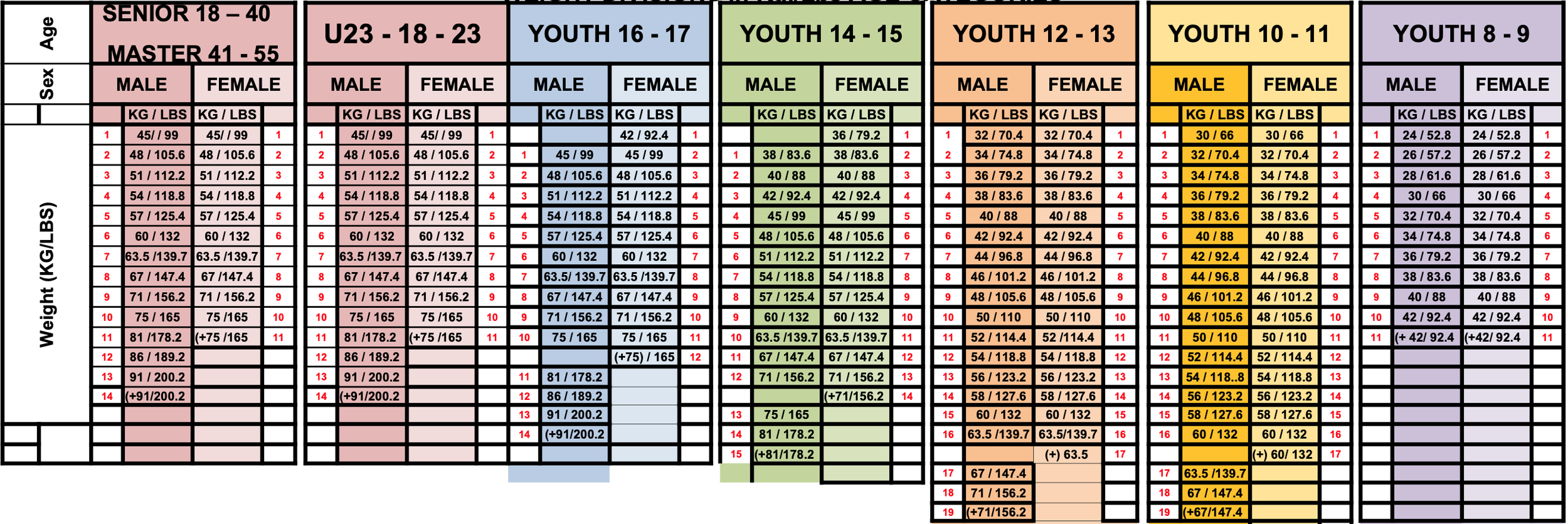
Muay Thai Ontario Amateur Weight Divisions
Best to fight at a similar weight class or a lighter weight class than a heavier one, as most athletes drop weight classes to compete. Note that height and build are not factors in match-ups; athletes can vary in body type despite being in the same weight class (e.g. tall and lanky versus short and stocky).
Although intense weekly training can contribute to weight loss, you may still find yourself outside of your weight division.If that is the case, consider healthy adjustments with your nutrition (e.g. controlled calorie deficit, adequate hydration and protein intake, key nutrient supplementation) and avoid unhealthy approaches that will weaken your body and compromise your performance (e.g., extreme calorie deficit, fad diets, elicit drugs, laxatives, smoking, sauna/bath dehydration, purging). Effective combat training requires adequate nutrition. Before adopting a new nutrition plan, ensure it aligns with your needs as a competitive athlete and comes from a legitimate source.
For more guidance on proper nutrition for fight camp, check out the following guides by The Fight Dietitian: “Nutrition for Female Combat Athletes” and "Fight Camp Cookbook” for recipes. TFD provides nutrition and weight-loss programs specifically designed for combat athletes, ranging from amateur to professional levels.
4. Rest and Recovery
While it is important to train often, you may experience burnout and be vulnerable to injuries if you do not take time to rest and prepare the body for movement. Do not make the mistake of only training hard and avoiding proper recovery: many fighters do not make weight, get injured before their fight and/or perform poorly because of poor recovery habits outside of training.
-
“Failure to prepare is preparing to fail.” - Benjamin Franklin
Having a pre and post-training stretch/mobility routine is key in your body’s ability to move well and injury-free. If you don’t already have a routine and need ideas, check out “Training Prep: A Better Way to Warm-Up” by GMB Fitness.
-
Aim for 8 hours of sleep a night (especially after grueling training sessions) to allow sufficient time for your body to recover.
The value of sleep can’t be overstated; lack of sleep impacts how we feel, behave, and move the next day leading to:
Increased cravings and hunger which can lead to excessive eating and weight gain
Mood changes (ie. irritability)
Difficulty concentrating and poorer memory retention
Higher chance of injury due to slower reflexes and compromised coordination
Weakened immunity and prolonged recovery from injuries or training sessions
Don’t sleep on sleep!
-
Have at least 1-2 rest days in the week to completely recover from training. This isn’t a cheat day to wreck your body with sweets, substances, or alcohol. If you’re itching to move, go on a light walk, shadowbox or stretch.
-
If you need help with chronic pain or an injury, consider seeing a physiotherapist, chiropractor or stretch/massage therapist (good thing we have a full team at Movement Patterns 😉)

5. Competition Fees
Competing is a rite of passage with added responsibilities and commitments for both athletes and gym staff. Consider the following:
• Gym Fight Camp Fee: In addition to group training, athletes must commit to additional training: one-on-one training with instructors and/or fighters only group training months before competition.
• Muay Thai Ontario Athlete Membership: MTO athlete membership allows athletes to compete in sanctioned Muay Thai events in the province for the calendar year. The membership also requires medical declaration (for all ages) and blood tests (for athletes 16 and older), the cost of which varies among physicians.
• Tournaments: $100+/tournament. Unlike most single-show events that do not require fighter registration fees, tournaments are massive events that require additional funding outside of promoters. Athletes can choose to compete only in single shows where there are little to no registration costs, but tournaments are also great opportunities to gain experience as they allow for multiple matches within a single weekend. However, tournament fees generally go up closer to the final date of registration, and they are the same amount whether you have a single opponent or multiple opponents in your bracket.